




Multimodal Optoacoustic Imaging
Optoacoustic (OA) imaging is a rapidly developing non-invasive, radiation-free biomedical imaging technology that combines the advantages of traditional optical and ultrasound imaging, offering broad application prospects in the biomedical field. However, OA imaging especially OA tomography (OAT) has inherent limitations, such as relatively low spatial resolution, relatively poor imaging sensitivity, and weak tissue contrast, which make it challenging to resolve fine internal structures, detect low concentrations of biological distributions, and provide detailed structural information. These limitations restrict the development and application of this technology. Multimodal optoacoustic imaging can leverage the strengths of OAT while overcoming these limitations, significantly expanding its development and application scope.
(1) Concurrent Fluorescence and Optoacoustic Tomography (FLOT)
Fluorescence imaging, with high sensitivity and specificity, is one of the primary methods in modern biological science research. However, wide-field fluorescence imaging suffers from significantly reduced resolution when imaging highly scattering tissues and lacks depth information. While optoacoustic imaging can improve sensitivity with contrast agents, the detection sensitivity of ultrasound transducers is much lower than that of photon detectors. Coupling these two imaging modalities has complementary mechanisms and important biomedical applications. However, OA tomography requires large-area transducer arrays and high-power pulsed illumination in the field of view, posing technical challenges in integrating a fluorescence imaging system in a physically constrained space with matched fields of view. To address these challenges, a fluorescence + OA imaging platform was designed and developed (Chen et al., Optics Letters, 42(22), 2017) (Figure 1a), achieving large-field (12 × 12 mm²) high-speed OA imaging (100 Hz) and high-sensitivity fluorescence imaging (50 Hz) of live biological tissue. This setup effectively overcame the bottleneck of integrating other imaging modalities in a space-constrained photoacoustic imaging system, enhancing the ability to capture transient information from live tissues. Through in vivo experiments, the imaging performance of OA and fluorescence imaging in different tissues with different contrast agents was revealed (Figure 1b, c), providing theoretical and practical guidance for clinical applications of fluorescence+ OA imaging (Chen et al., Biomedical Optics Express, 9(5), 2018; Chen et al., Biomedical Optics Express, 10(10), 2019). Notably, OA + fluorescence imaging not only enhances imaging sensitivity but also increases the dimensionality of information acquisition. By simultaneously capturing three-dimensional signals of neuronal activity (GCaMP) and hemodynamic parameters (oxy-/deoxy-/total hemoglobin and blood oxygen saturation) in the brain (Figure 1d-j), it effectively expands the capabilities of current neuroimaging methods, providing technological support for the study of brain function and neurodegenerative diseases (Chen et al., Advanced Science, 9(24), 2022).
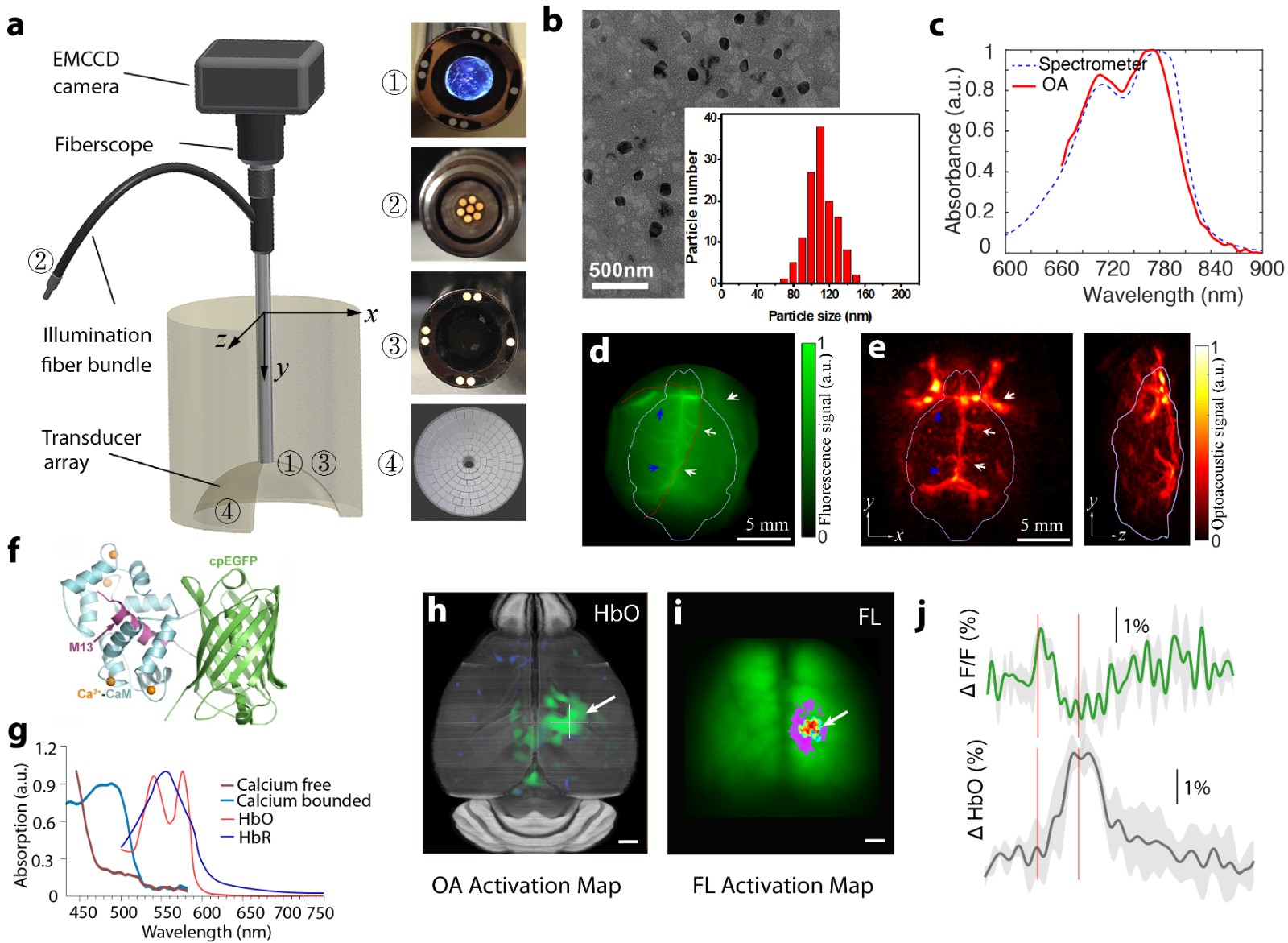
Figure 1. Dual-modality Optoacoustic + Fluorescence Simultaneous Imaging Platform and Applications. (a) Simultaneous imaging platform. (1-4) Schematics of the fiber optic imaging bundle, illumination fiber input port, output port, and ultrasound transducer array. (b), (c) Fluorescence and OA images during fluorescence contrast agent perfusion. (d), (e) Simultaneous fluorescence and OA imaging results during ICG infusion via the mouse tail vein. (f) Chemical structure of the GCaMP fluorescent protein. (g) OA absorption curve of various endogenous signals. (h)-(i) OA and fluorescence activation patterns and response curves of the mouse brain under external electrical stimulation.
(2) Concurrent Magnetic Resonance Optoacoustic Tomography (MROT)
Hemoglobin's extinction coefficient dominates within biological tissues, and the extensive vascular network throughout the body, along with the low spatial resolution of photoacoustic tomography, collectively results in low image contrast and a lack of structural information, greatly limiting the application of OAT in biomedicine. Magnetic resonance imaging (MRI) can provide high-resolution soft tissue contrast, with complementary spatial and temporal resolutions to OAT. Although the blood oxygen level-dependent (BOLD) signal in functional MRI is the most widely used physiological parameter in neuroscience research, the complex mechanisms behind BOLD remain unclear. OAT can offer multi-component hemodynamic signals, enabling effective interpretation of physiological signals when combined with MRI. Traditionally, due to strong magnetic interference, OAT and MRI data can only be collected separately, leading to issues with image registration and physiological state synchronization during post-processing. To achieve simultaneous imaging, an OA device compatible with ultra-high magnetic field strength (9.4 Tesla) was designed, a solution to eliminate magnetic resonance RF signal crosstalk was proposed, and the world's first hybrid magnetic resonance optoacoustic tomography (MROT) platform for in vivo imaging was successfully developed (Figure 2). This breakthrough addresses the challenges of low contrast and lack of anatomical information in OAT images (Chen et al., Light: Science & Applications, 11(1), 2022). OAT provides molecular information and blood oxygen metabolism data that MRI cannot measure. By conducting a multi-parameter activation response study of the mouse brain under external electrical stimulation, simultaneous real-time measurements of multi-parameter hemodynamic signals and the BOLD signal were obtained. This revealed high spatiotemporal correlation between different activation patterns and the underlying causes of BOLD signal changes, enabling synergistic interpretation of photoacoustic and functional MRI BOLD signals (Figure 3) (Chen et al., Advanced Science, 10(3), 2022).
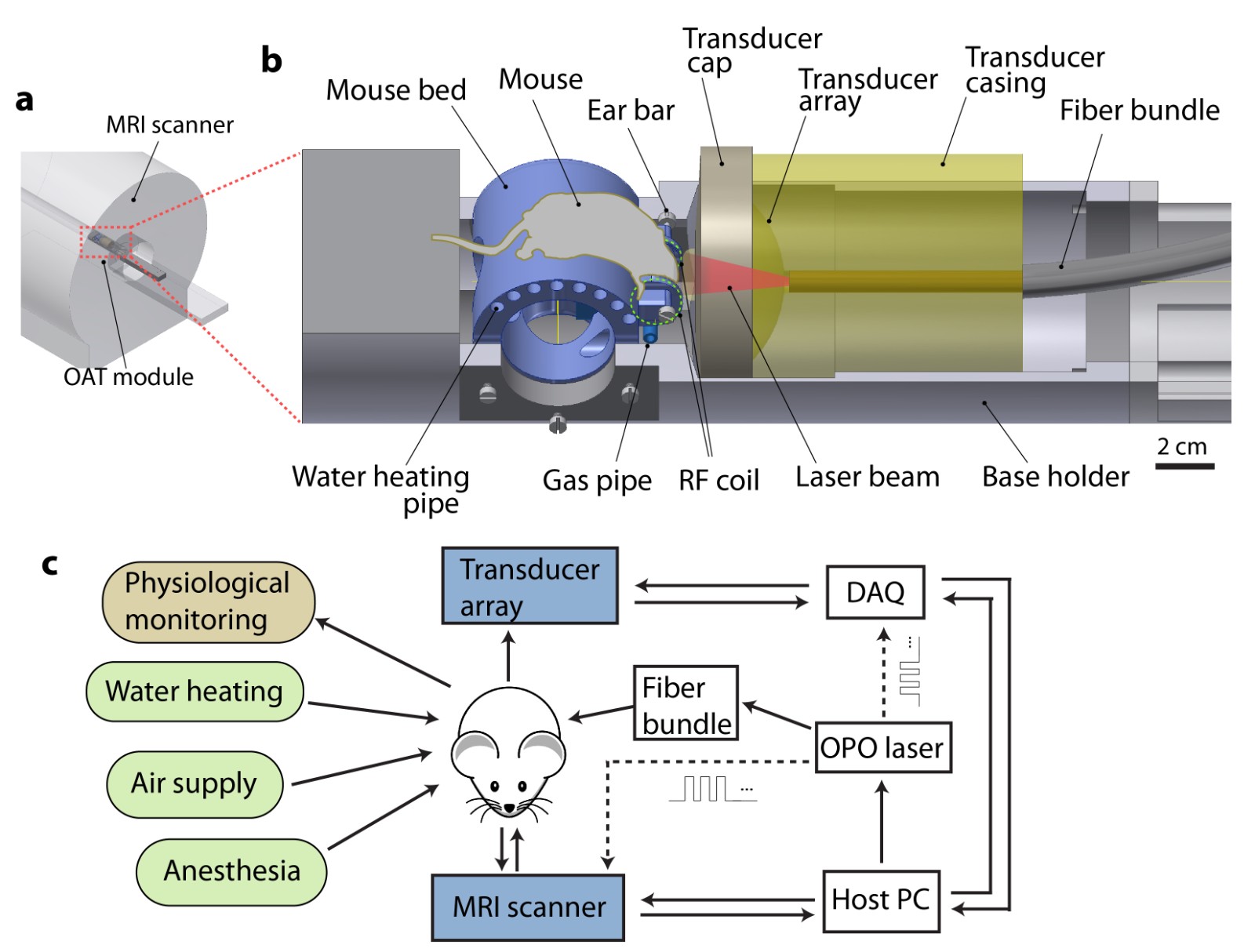
Figure 2. Hybrid magnetic resonance optoacoustic tomography (MROT) platform.
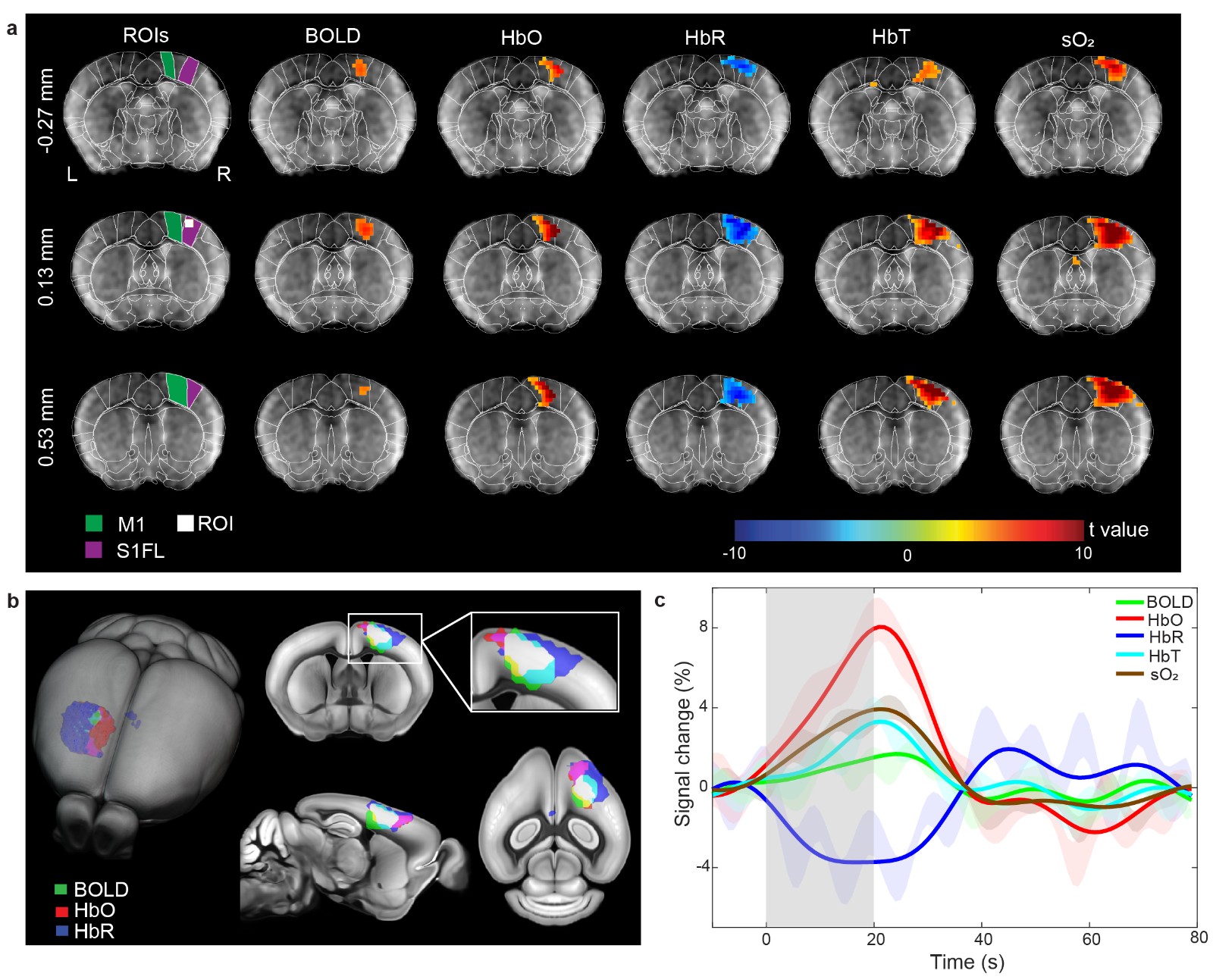
Figure 3. Activation response results of the mouse brain to external electrical stimulation obtained from the MROT platform. (a) Activation patterns corresponding to OAT and BOLD signals on different planes of the mouse brain. (b), (c) Spatiotemporal correlation of activation patterns of different hemodynamic signals in the somatosensory cortex of the mouse brain in response to external electrical stimulation.
References
Z Chen, I Gezginer, Q Zhou, et al., "Multimodal optoacoustic imaging: methods and contrast materials," Chemical Society Reviews 53, 6068-6099(2024).
Z Chen, I Gezginer, M Augath, et al., "Simultaneous Functional Magnetic Resonance and Optoacoustic Imaging of Brain‐Wide Sensory Responses in Mice, " Advanced Sciences 10 (3), 2205191(2023).
Z Chen, I Gezginer, M Augath, et al., "Hybrid magnetic resonance and optoacoustic tomography (MROT) for preclinical neuroimaging," Light: Science & Applications 11:332(2022).
Z Chen, Q Zhou, XL Deán-Ben, et al., "Multimodal Noninvasive Functional Neurophotonic Imaging of Murine Brain‐Wide Sensory Responses, " Advanced Sciences, 2105588 (2022).
R Ni*, Z Chen*, XL Deán-Ben*, et al., " Multiscale optical and optoacoustic imaging of amyloid-β deposits in mice," Nature Biomedical Engineering 6, 1031–1044 (2022).
Z Chen, A Özbek, J Rebling, et al., "Multifocal structured illumination optoacoustic microscopy, " Light: Science & Applications 9 (1), 1-9 (2020).
Z Chen, XL Deán-Ben, N Liu, et al., “Concurrent fluorescence and volumetric optoacoustic tomography of nanoagent perfusion and bio-distribution in solid tumors,” Biomed. Opt. Express 10 (10), 5093-5102 (2019).
Z Chen, XL Deán-Ben, S Gottschalk, et al., "Performance of optoacoustic and fluorescence imaging in detecting deep-seated fluorescent agents," Biomed. Opt. Express 9, 2229-2239 (2018).
Z Chen, L Dean-Ben, S, Gottschalk, et al., “Hybrid system for in vivo epifluorescence and 4D optoacoustic imaging”, Opt. Lett 42, 4577-4580 (2017).